Start with what the yard needs
Before the first call, walk the yard. Look at the front, the back and any side yards. Note the grass type if you know it. Check the gates and whether they lock. Make a mental list of what matters to you: the lines along the walk, the hedge off the window, the beds under the azaleas, the fire ant mound by the fence. The call goes much better when you can describe the yard in a couple of sentences.
Four things to settle on the first call
These work with any lawn service, whether you want a weekly schedule or a single cut.
What the yard needs
Front, back and side yards, the grass and how tall it is, and any hedges or beds.
How the schedule runs
How often the cuts come in season, and what changes in the slow months.
Gates, dogs and access
Who opens the gate, where the dog stays, and whether anyone needs to be home.
Where the clippings go
The City-Parish expects hired crews to remove their own debris, so ask how the crew handles it.
Source: City of Baton Rouge and Parish of East Baton Rouge, Garbage Collection.
The questions in that figure fit most yards. For a yard that is already past the mower deck, add a fifth: how is a tall first cut handled? The first cut on a tall lawn is a different job than a routine mow, and treating it the same way lines a crew up for a bad day.
Ask what a routine visit actually covers
What a crew does on a visit is more useful than what the quote lists. The front, the back, any side yard, the edges along the walk and the drive, trimming around trees and fence posts, where the clippings end up: all of that either sits inside a routine mow or it does not.
Ask what happens with the clippings on a routine visit, and how edges and string trimming fit into the time. Ask how the price works when a yard is tall on the first visit, since that is a different cut than week ten. Ask what the fall visits look like when the growth slows down, and what the winter looks like for yards that go dormant.
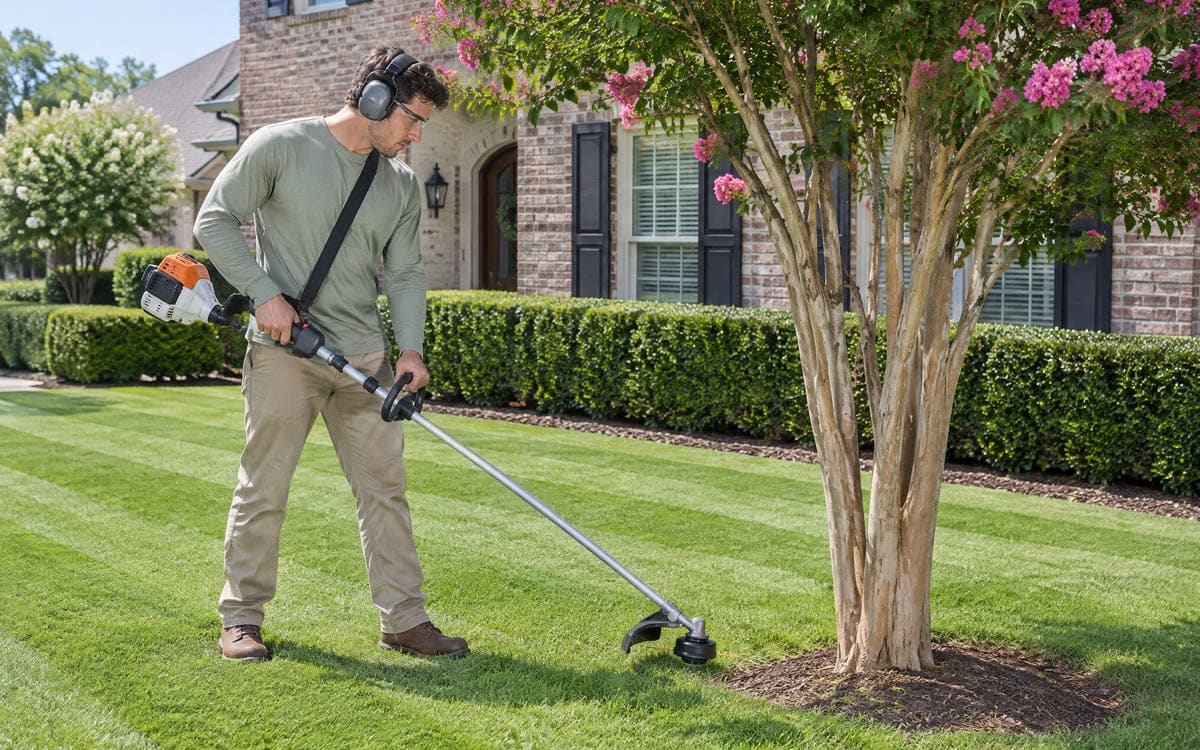
A routine visit on a reasonable yard runs a familiar order: a walk of the front, back and side yards for sticks, toys, dog stakes, sprinkler heads and fire ant mounds; the cut at the right height for the grass that is in the lawn; string trimming at fence lines, posts, the mailbox and around trees, with the line kept off tree trunks, siding, windows and cars; and a stick edger pass along the walk, the drive and the curb. Grass cutting walks through what we do on a routine mow, so comparing it to what any crew tells you is a fast way to feel out how settled their routine really is.
Ask how the schedule works through the year
A season in Baton Rouge is long. Louisiana lawns run about once a week, or three to four times a month, during the active growing season. That is a lot of weekly visits in a year, and the questions that come up over that span are what any schedule has to answer.
The useful questions on scheduling are concrete. Does the weekly rhythm hold through summer rain or does it slip? What happens on a rainy mowing day? What does the fall slowdown look like, and when does the schedule drop to every other week? Does the service skip the dormant months, or stay in touch for the quiet jobs? Clean answers tell you the crew has worked out their year; vague ones usually mean they have not.
A weekly or every-other-week schedule is what a routine season looks like here, and the full year on a mowing schedule walks through where the warm months sit and where the quiet weeks fall.
Gates, dogs and side yards belong in the first call
The parts of a yard that are easy to forget are the ones that cause missed cuts. A back gate with a padlock means the cut either waits for a code or does not happen. A dog that comes outside through a doggy door needs to stay in while the mower runs, or the cut waits. A long side yard that no one mentioned adds work nobody priced and surprises both sides.
Any good crew will ask. If they do not, your yard is being quoted against their default picture, which is how clients and companies end up in disagreements by week three.
Ask where the clippings and trimmings go
How a crew handles its own debris is one of the clearer signals you get. Under the City-Parish's curbside program, landscapers, arborists, and other tree maintenance or removal companies are responsible for debris removal; residents who perform their tree maintenance or removal are responsible for debris removal services. The question to ask a hired crew is how their clippings leave the property.
Parish code counts yard clippings as litter and bans sweeping litter from a lot, sidewalk or driveway into a gutter or street. A shrug about the clippings question, or a last visit that left debris at the curb line, is worth noting before anything is agreed.
If you want the beds handled along with the lawn, hand weeding is a separate job; ask any crew whether they do bed weeding and how the pulled weeds leave the property.
A price after a look beats a price over the phone
A quote from someone who has not seen the yard is a guess, and a guess usually lands either high enough to protect the crew or low enough to need adjusting later. A quote after a look is a number for the actual yard. A quick drive-by with a few photos sometimes works for a routine mow. For anything with a bed, a hedge, a gate or a slope, a short visit works better.
What goes into a lawn care price walks through the drivers in detail. The short version is that the price follows the work, and the work is in the yard rather than the ZIP code.
If the first look is a short visit, use the time to walk the yard together. Watching a crew look at a gate latch, test the mower against a side-yard width, and point at an edge the string trimmer will touch is useful to see in person. The same walk is a chance to point out the yard's own small items: a sprinkler head, a loose paver, a bed line you want kept.
Red flags show up before the first cut
Most problems with a hired yard crew are visible in the first conversation. A short list of what to notice:
- A hard quote over the phone with no questions about your yard.
- No mention of what happens to the clippings, or a plan that ends at the gutter.
- Pressure to sign a contract on the first call before anyone has walked the yard.
- A price that is far below the others, with no explanation of what is included or left out.
- Extra work added on the day the crew is there, without a question asked beforehand.
- No answer, or a vague one, about what happens on a rainy mowing day.
| Question to ask | Why it matters | A good sign in the answer |
|---|---|---|
| What is included in a mow? | Scope sets the price | Edges, trimming, bagged or back on the lawn |
| What happens on a rainy day? | Weeks shift here | The schedule bumps, the yard waits a dry window |
| Where do the clippings go? | The crew's debris is the crew's to handle | Hauled away, or back onto the lawn, never swept |
| Who handles the gates and dogs? | Access decides whether the yard gets cut | A plan agreed before the first visit |
| How is the first cut quoted? | Tall grass changes the job | A separate price if the lawn is past the deck |
| What about hedges and beds? | Each is its own work | Priced on top, or a separate visit |
Hedge trimming and edging and string trimming are the two other services most routine visits touch. Plain-language answers on each one are easier to work with than a single bundled quote that lumps everything together.
The same questions work for a one-time cut
Not every yard needs a weekly crew. Someone traveling for a month, someone whose own mower is broken, someone who just moved in and inherited a yard that is close to overgrown might only want one visit. The same questions still fit, with one more on the end about whether the schedule continues or whether one cut is enough.
The one place one-time cuts diverge is on the tall first cut. A yard that has been sitting for a month in a wet summer has grown differently from one that was mowed last week, and the mower that handles it needs a different approach. The first cut on a tall lawn walks through what that visit looks like. If the yard has crossed into that territory, say so when you call so the crew knows what to bring and how to plan the pass.