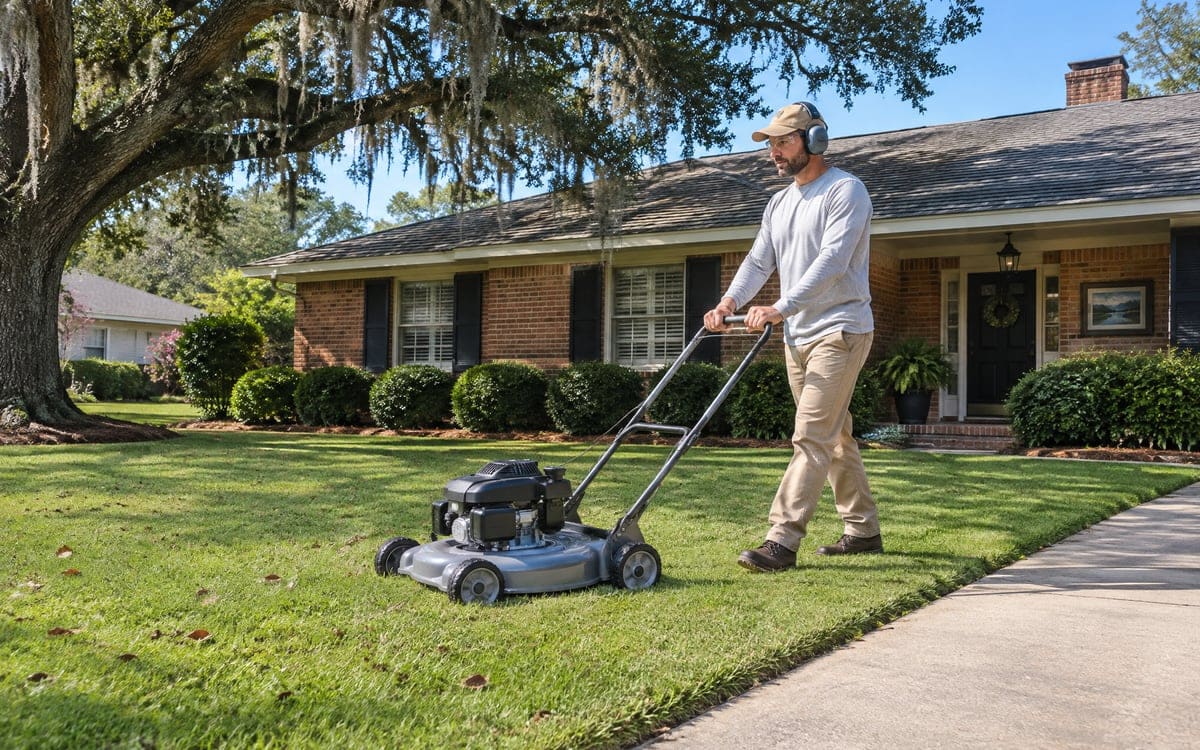
Grass slows down in fall but keeps growing
October is the handoff month. Warm-season turf runs on a cycle of active growth from March through October, then dormant from November through February. On the ground the transition is softer than the chart. A Bermuda lawn that was pushing hard in August is slower in October, but it is not stopping. Cool mornings and warm afternoons still ask the lawn to grow.
Fall lawns need regular mowing to maintain proper height even as cuts come less often than they did in summer. The signal for when to cut is how long the grass takes to grow back to needing one. When that stretches, the gap between visits stretches with it.
Regular cuts hold the height the lawn needs
Fall is the season when a lot of yards look finished when the lawn is still growing. Even on a slower calendar, it is still important to mow regularly to maintain proper height and make sure that mower blades are still sharp. A lawn that gets ignored through October and then takes one big catch-up cut in late November is a lawn that goes into winter at the wrong height.
A weekly or every-other-week schedule is how we hold the height through the slowdown. The height set in July is the height the mower stays on through the fall. Letting the deck drift lower because the grass is growing slower is one of the ways fall yards get into trouble. The heights by grass are the subject of grass cutting at the right height for your grass.
A yard that is a mix of sun and shade reads differently in fall. Shaded grass tends to grow more slowly than grass in the open. The crew reads the growth across the yard rather than mowing by the calendar.
A fall visit opens the same way a summer visit does: a walk of the front, back and side yards for sticks, toys, dog stakes and sprinkler heads, with fire ant mounds pointed out and left alone. Leaves scattered on the lawn stay for the deck to pick up on the pass. Anything the mower cannot pass over gets lifted first. The deck is set for the grass that is in the yard, with the height picked for the slower months rather than the lowest end of the range.
Sharp blades matter as the season winds down
The number of cuts drops in fall, which makes each cut count more. A rotary mower blade becomes noticeably duller after a few cuts and should be sharpened as needed, and tough grasses like zoysia will dull a blade quickly. A sharp blade slices the leaf; a dull blade frays it, leaving tan tips across the lawn that look like drought a week after the mow.
In October and November the lawn is already starting to look less vigorous because of the season. A ragged cut on top of that reads as dieback when it is actually dull steel. The fix is boring: the blade gets sharpened on schedule and swapped when needed, so each one of the fewer fall cuts leaves the yard looking cut rather than torn.
Zoysia lawns are the ones most likely to trip up a crew on sharpening. A mower that handled a Bermuda yard all summer can show its wear fast on a neighbor's zoysia, and the gap between cuts in fall is longer anyway, so sharpening between visits is the simple answer.
Low cuts in fall set up spring trouble
The temptation in fall is to scalp the lawn one last time, as if a shorter cut buys fewer cuts over winter. Taking the lawn down low on the last mows of the season does the opposite: it stresses the plant going into dormancy and opens the stand to a Louisiana problem.
Large patch is the top winter and spring lawn disease in the state, and is favored by poor surface and subsurface drainage, leaf canopy moisture, stagnant humid air and cloud cover, and turf mowed too low is more susceptible to large patch infection than turf mowed at the proper height. Keeping the mower set to the right height for the grass through October is the simplest defense.
Into winter at the right height, or too low
Fall growth slows, but the height still matters. Large patch is the top winter and spring lawn disease in Louisiana.
Mowed at the right height
- Regular cuts through fall, even when the lawn needs them less often.
- Sharp blades to the end of the season.
Mowed too low
- More likely to get large patch.
- Poor drainage and stagnant, humid air favor the disease.
Sources: LSU AgCenter, Fall and Winter Lawn Care; LSU AgCenter, Last-Minute Lawncare: What To Do This Spring.
LSU AgCenter's turf guidance is to raise the mowing height before an expected stress period such as heat, cold, frost or drought. The last stretch of fall is a stress period for warm-season grass, so a raise before the first freeze is more useful than a drop. The point is to carry the lawn into dormancy as a full, well-covered stand.
The height numbers themselves do not change in the fall. St. Augustine wants 2.5 to 3 inches, centipede 1 to 2 inches, bermuda 1 to 2 inches, zoysia 1 to 2 inches and carpetgrass 1.5 to 2. The deck stays set for the grass that is in the yard, with the right end of the range picked for the slower months.
Leaves on the lawn get mowed in
Leaves land on the lawn through October and November. On a mowing visit the deck chops them up along with the grass, and a thin scatter of mulched leaves on a warm-season lawn breaks down on the ground. A thick unmulched layer blocks light the same way a thick clipping layer would, and the stand underneath thins out when the light is gone. Regular cuts keep the mower ahead of what falls between visits, which is one of the reasons the schedule does not just disappear in October.
A longer gap in the fall means a heavier pass through the deck on arrival, so a yard that was on a weekly rhythm all summer sometimes benefits from staying close to that rhythm into the first drop before stretching the gap out. How often we come changes the price, partly for that reason, and partly because the time a crew spends in the yard moves with how much is on the ground.
The first freeze usually ends the season
A fall schedule runs toward a stopping point. The last routine cut of the year is often the one before the first real freeze.
The airport's median first freeze comes around November 26, with one year in ten seeing it by November 7. The last cuts of the year run up to that line, with the gap between them stretching as growth slows. After the first freeze most warm-season lawns have browned off enough that a routine cut is not useful, and the schedule drops away.
The caveat is that the median is a median. A late first freeze pushes the last cut later; an early November cold snap pulls it in. The crew watches the forecast with the yard; a routine mow does not get forced on a frosted lawn, and a mow in warm December weather after a late freeze is fine if the yard calls for it.
The finish work at a fall cut matches the summer visit. A stick edger drops a narrow vertical pass at the walk, the drive and the curb, and the string trimmer finishes the fence line, posts, the mailbox and around trees, with the line kept off tree trunks, siding, windows and cars. Clippings stay on the lawn when the cut is at the right height and small enough to settle in, and bagged when a longer gap or a wet pass has left clumps.
St. Augustine may never go fully dormant
Not every warm-season lawn here goes brown and stops. Most warm-season grasses will be completely or partially dormant by mid to late November or December, with St. Augustine the exception that may not go completely dormant during mild south Louisiana winters. A St. Augustine yard that holds a dull green through December is normal here in the milder years.
A St. Augustine lawn that is clearly still growing into December may want one more cut after the first freeze if the grass has pushed over the target height, and sometimes a light cut after Christmas if the weather has been mild and winter weeds are towering above it. A Bermuda, centipede or zoysia yard next door, cut on the same schedule all summer, probably does not. The full year on a mowing schedule walks through how those grasses handle the quiet months.
The weeds are their own story. Weeds such as clover, lawn burweed and annual bluegrass keep growing while the lawn looks dormant. A light cut to knock the weeds back is a judgment call rather than a routine mow, and a yard with heavy winter weeds in the beds is usually better served by hand weeding than a mower that would run over flower-bed edges.