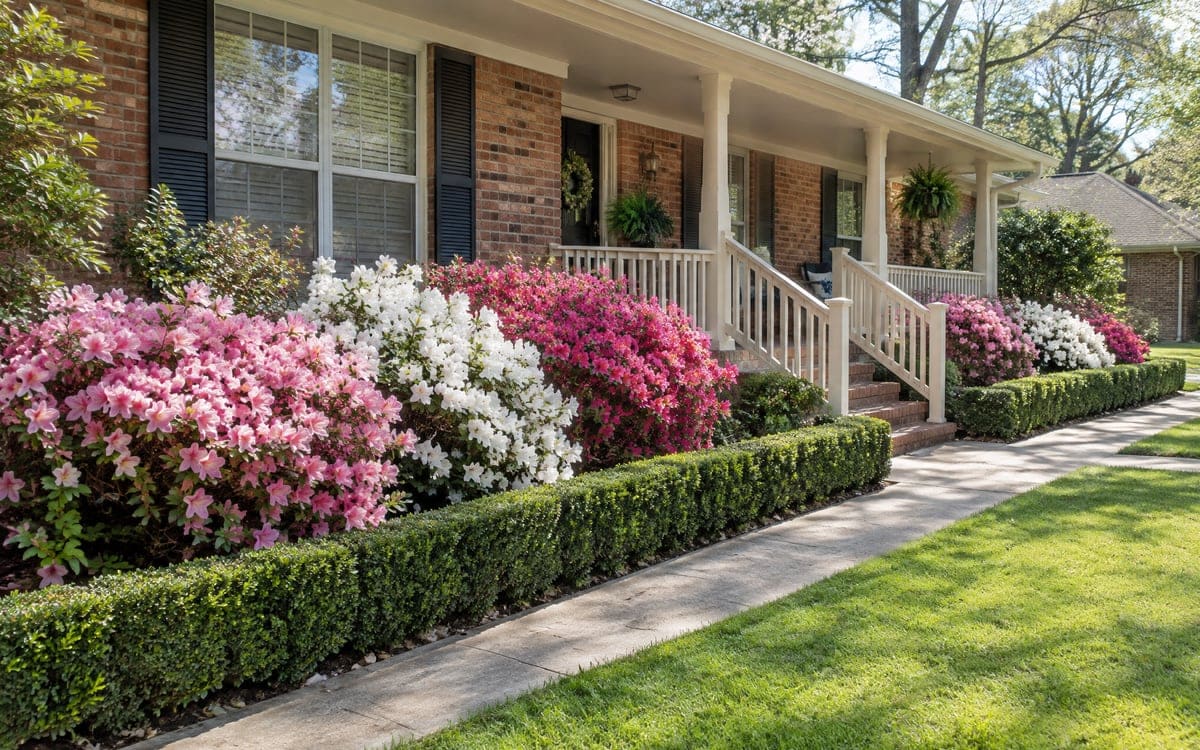
Growth sets the calendar for a hedge
A hedge is trimmed when it has grown enough to need it and when a cut will not leave the plant open to trouble. In Baton Rouge, the warm months stretch across most of the year. Warm-season turf is in active growth from March through October, and shrubs push through those same months. A hedge in this climate usually sees several trims a year rather than one.
The idea behind every cut is to take a little at a time, so the hedge keeps its line without losing its depth. A hedge trimmed hard once a year ends up thin at the base, bare on the inside and prone to brown patches that will not fill in on their own. Hedge trimming covers what a visit does; the question of when a particular hedge gets trimmed depends on the plant.
Late winter is the quiet window
The quiet window for most clipped evergreens in Baton Rouge is late winter, after the hard cold snaps are done and before new spring growth starts in earnest. The airport's median last freeze is around February 25, with one year in ten still seeing a freeze as late as March 19. A trim taken in that late-February or early-March window shapes the hedge going into the growing season rather than during it.
The freeze windows at each end of the hedge year
Each window runs from the median freeze date at the airport to the later or earlier date that comes one year in ten.
- Late freeze still possible: Feb 25 to Mar 19
- Early freeze possible: Nov 7 to Nov 26
Source: NOAA NCEI U.S. Climate Normals 1991-2020, Baton Rouge Ryan Airport.
Show the numbers behind this chart
| Date | What |
|---|---|
| February 25 | Late freeze still possible begins |
| March 19 | Late freeze still possible ends |
| November 7 | Early freeze possible begins |
| November 26 | Early freeze possible ends |
A hedge trimmed in that window is not being pushed into soft new growth that a cold snap can burn, and the new spring growth that follows comes in on a shape already reset for the year. The quiet season is also a reasonable time to look at weeding the beds under the hedges.
That one-in-ten March freeze is the reason to watch the forecast on a late-winter trim. If a cold night is coming the trim can wait a few days. In most years the shift is small, and the window is wide enough to catch a dry morning.
Spring bloomers wait until the flowers fade
Spring-blooming shrubs are the main exception to the late-winter rule. Azaleas set their flower buds in summer for the next year's bloom. Trim an azalea in late winter and you cut off the buds that would open the next spring. The usual answer is to trim azaleas right after they finish blooming, before the plant sets next year's buds.
Spring bloomers and clipped hedges keep different calendars
Azaleas and other bloomers wait until the flowers fade, while a clipped hedge takes light trims all through the growing season.
Azaleas and other spring bloomers
- Trimmed soon after the flowers fade.
- A trim late in summer or in fall can take off next spring's buds.
Boxwood, ligustrum and other hedges
- Several light trims through the growing season.
- Kept a little wider at the base than the top, so the bottom stays full.
The rule of thumb for any spring-blooming shrub is to trim it just after the flowers fade. One shaping cut after the bloom is usually enough for the year on an azalea; a second light touch early in the summer that follows is sometimes useful for a tall older plant that is pushing a lot of new growth. Cuts later in the warm season start to risk the next year's buds again.
Camellias, like azaleas, are trimmed after they bloom.
Boxwood and ligustrum take several light trims a year
Boxwood and ligustrum are two common formal hedges along driveways and front walks. Both grow steadily from early spring through fall, and both keep a cleaner line with a few light trims rather than one hard cut.
| Shrub | When it is usually trimmed | Why |
|---|---|---|
| Boxwood | Late winter and a few more times through the warm months | Slow steady grower; light trims keep the shape without stressing the plant |
| Ligustrum | Late winter, late spring, mid-summer | Fast grower; needs attention through the warm months to stay crisp |
| Azalea | Just after bloom | Flowers on buds set the previous summer |
| Camellia (sasanqua, japonica) | After bloom; sasanquas in late fall or winter, japonicas in early spring | Also flowers on buds set earlier in the year |
Boxwood tolerates light trimming almost any time, so several light trims a year is normal on a well-shaped boxwood hedge. Ligustrum is faster; a hedge trimmed in late winter can look shaggy by June, so a second cut in late spring and a third in mid-summer are normal. Each trim holds the shape rather than resetting it.
A hedge trimmed to a shape where the base is at least as wide as the top keeps light reaching the lower branches, which keeps the leaves on down to the ground. A hedge that gets narrower at the base over several hard trims opens up along the bottom and does not fill back in on its own. The common fix is a few seasons of light work on a wider base, letting the plant grow back toward the shape it should have had.
Summer growth needs the most attention
July and August are the fast months. Baton Rouge averages about 96 days a year that reach 90 degrees, about 70 of them in June, July and August. Warm, wet weather is good for new growth, and a ligustrum hedge pushes hard through the summer heat.
Early morning, before the heat builds, is easier on the plant and the crew, with water close at hand. A hedge that needs several passes in the warm months gets them in the cooler part of the day.
The beds underneath are worth a look on a summer visit. A hedge that comes down to the ground often shades out most of what tries to grow there, but Virginia buttonweed and nutsedge have a way of finding the gaps. Edging along the beds fits with that same visit on many yards.
Rain shapes trim days too. June is the city's wettest month on average at 6.45 inches. A trim day that lands on a rainy stretch slides a few days without hurting the plant. Clippings on wet soil clump the same way wet grass does, so a dry morning is simpler than one chasing a storm.
A trim close to the first freeze can wait
The season at the other end of the year runs toward the first freeze. The airport's median first freeze comes around November 26, with one year in ten seeing it by November 7. A hard trim close to the first freeze can push the hedge into soft new growth right before cold weather hits, which is where you get tip burn and dieback.
The usual move is to leave plenty of time between the last real trim of the year and that median first freeze, so the plant has time to harden off before any cold comes in. A light touch-up on a noticeably shaggy run is fine; a serious cut close to the freeze is not. The lawn as a whole has entered its own quieter stretch by then too, which is what the mowing calendar walks through.

Clippings go out the way the City-Parish asks
A long ligustrum run can produce a surprising amount of clippings; a boxwood trim bags up more quickly. The City-Parish states that landscapers, arborists and other tree maintenance or removal companies are responsible for removing their own debris.
How the crew's trimmings leave the property is one of the things we settle when we price the job. What a hedge adds to the price walks through how a hedge is quoted.
For residents setting out their own hedge waste, the City-Parish rule is that leaves and lawn trimmings go in bags, brush goes in bundles, each in its own pile, and branches can be no longer than 5 feet, no thicker than 6 inches, and no heavier than 40 pounds an item, with piles at the curb in the public right-of-way, at least 3 feet from carts and other piles; collection crews will not go onto private property. Parish code sets the same limits: 40 pounds a bag or bundle, 10 yard waste items per collection, and no stumps, trunks or limbs over 6 inches thick. Nothing from a trim is swept into the street or a storm drain.
A regular hedge rhythm folds in with a regular schedule for the lawn. When the mowing crew is already on-site every week or two, a short hedge pass on the day a trim is due is simpler than a separate trip.
A trim visit opens with a walk of the row and a look at the shape you want kept, the windows and walks to clear, and any blooms to wait for. A tarp goes down along the base so clippings land on the tarp and not in the bed or on the siding. The trimmer or the shears stay in both hands at chest height or lower, and the crew moves along the row at a steady pace. Clippings come off the tarp into bags or bundles at the end. A last look along the row catches a corner that could still take a second pass before we go.