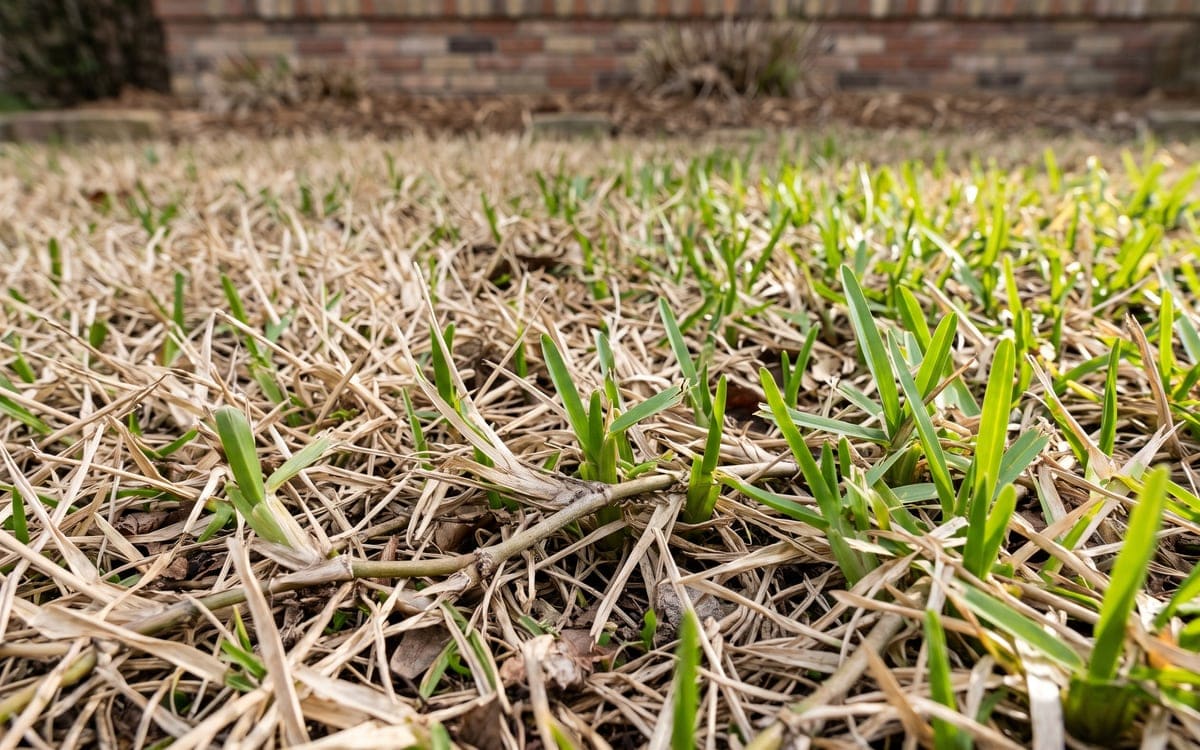
January tan is the usual winter look
Warm-season grasses here go to sleep for winter. The grass is in active growth from March through October, dormant from November through February.1 A tan lawn in January is a lawn doing what the calendar says it should.
The lawn is not dead. The top is tan because the blades have shut down for the year, but the crowns, roots and runners underneath are still alive. Most warm-season lawns here go fully or partly dormant by mid to late November or December, though St. Augustine may not go completely dormant in a mild south Louisiana winter.2
Green-up usually begins in late February
The season does not restart on a fixed day. Lawns in south Louisiana can start greening up in late February.3 The first green is a tinge rather than a full green yard. Shoots push up through the tan cover a few at a time, and from the street the color looks the same at first.
The grass's own pace runs on ground temperature. Warm-season turf is not fully awake until the soil reaches a minimum of 60 degrees.4 A January green patch on a non-St. Augustine yard is often a weed, not the grass; a St. Augustine yard that holds color can look different because St. Augustine may not go completely dormant in a mild south Louisiana winter.2
How to read a yard in late winter
A warm week in January does not green the yard up on its own.
A yard that shows real green across most of the stand, with new shoots in the thin spots and the color brightening week to week, is a lawn in green-up. A yard with scattered green patches in a mostly tan stand is often something else: cool-season weeds, St. Augustine holding color, or a specific issue in that patch.
Patches that stay tan are worth a closer look
A patch that is still tan while the rest of the yard greens up is one to inspect. The signs to look for are visual, from a safe distance. Does the tan patch have any green shoots at ground level, down in the stand. Is the color flat tan, or does it include dry straw-colored stems. Is the shape of the patch regular, like a strip in a shady corner, or an irregular blotch.
Large patch is one disease LSU AgCenter names
Large patch is the first disease that comes to mind in winter and spring,4 favored by poor surface and subsurface drainage, leaf canopy moisture, stagnant humid air and cloud cover. The same page says turf mowed too low is more susceptible to large patch infection than turf mowed at the proper height.4
What our visit does with that: run the mower at the right height for the grass in the yard. Cutting at the right height is on the mowing side. Treatment of a specific disease is not something our visit covers.
The first spring cut waits for real growth
The lawn tells you when it is ready for the first cut. LSU AgCenter advises picking up sticks and winter debris before the first mow of spring, with that first cut going a little lower than normal.4 Both of those depend on the lawn being clearly in growth.
The sign to watch for is the stand getting taller as a whole, not just one or two blades. Once the lawn is clearly growing, the first cut can run and the usual weekly or every-other-week rhythm starts up. Weekly mowing on a schedule and cutting at the right height for the grass carry the lawn through the first few weeks of spring, when the stand is still filling in.
The pattern of a lawn as it wakes
A yard coming out of dormancy follows a rough pattern a homeowner can watch for.
| What you see | What it is likely |
|---|---|
| Flat tan across the lawn in January | Dormant, following the usual winter pattern |
| Scattered green patches in a tan lawn in January | Cool-season weeds, or a St. Augustine stand holding color |
| Green tinge across the stand in late February | Early green-up starting |
| New shoots across the yard in spring | Lawn is waking up |
| Irregular tan patches while the rest is greening up | Worth a close look |
Look at how the whole yard reads, not any one color. A yard that stays tan in a specific patch deserves a slower look.
When a lawn does not come back
If a lawn has patches that stay tan after the rest of the yard greens up, those patches are not something a mowing crew replants. Our visit on a lawn with bare spots is to keep the healthy stand around them cut well.