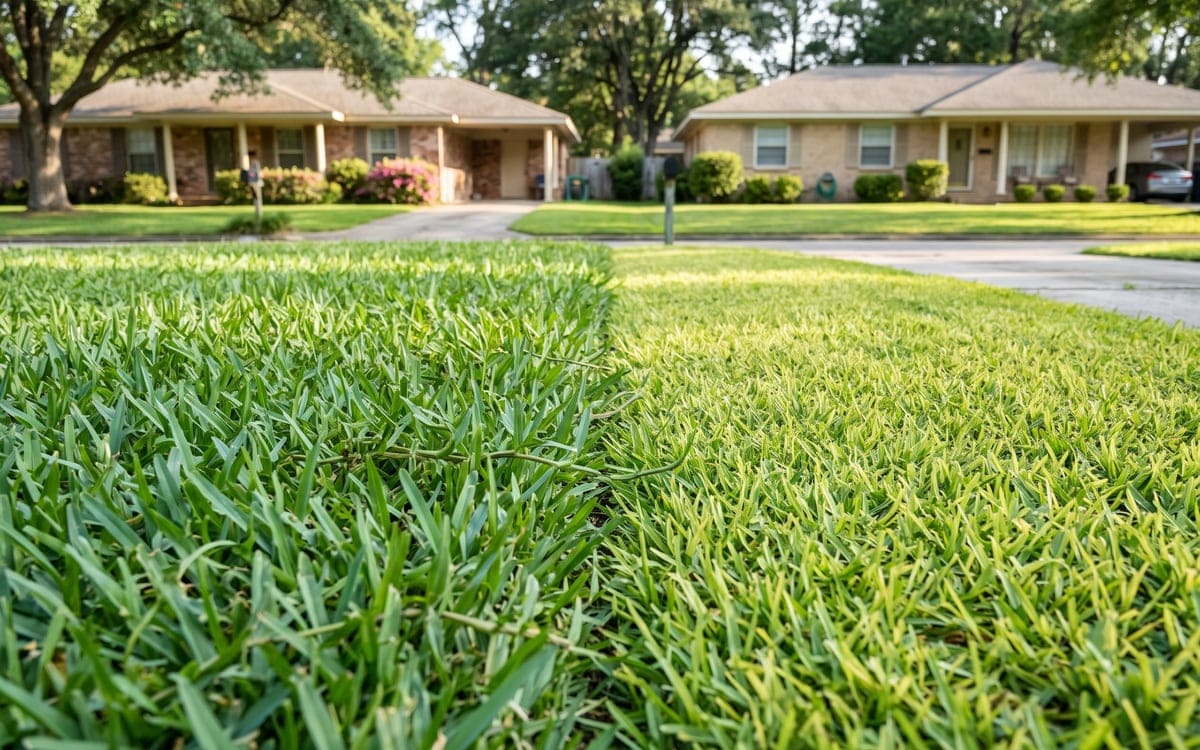
Baton Rouge lawns run on a warm-season cycle
Warm-season grasses grow in heat and go dormant in winter. LSU AgCenter's calendar puts active growth from March through October, dormant from November through February.1 The tan winter look is the usual pattern, not a problem.
St. Augustine has wide blades and tolerates shade
St. Augustine blades are wide, blunt-tipped and a deep green or blue-green. The grass spreads by thick runners above the ground.
Shade is its headline trait. St. Augustine is a popular choice because it is well-suited to warm, humid weather, and is the warm-season turf with greater shade tolerance.2 It also has a low tolerance for cold temperatures.2
Centipede is slow and low upkeep
Centipede is the yellow-green grass of the group. The blades are narrower than St. Augustine, lighter in color, and the lawn has a soft, slightly washed look even when it is healthy. It is popular because of its low maintenance requirements, and because it grows in warm weather and acid soils with low nitrogen fertility.3 It is slow growing and spreads through stolons too.
Centipede does not take hard use well. Increased traffic causes soil compaction that leads to centipedegrass stress expressed as purple to red leaves.3
Full sun suits Bermuda
Bermuda has thin, fine blades, and a healthy Bermuda lawn is a dense carpet of fine green. The grass is tolerant of traffic, heat and drought, and it prefers full-sun areas and does not grow well in partially shaded to heavily shaded areas.4
Zoysia and carpetgrass
Zoysia is a fine, dense grass that holds a flat, carpet-like look when kept at the right height. Rotary mower blades fray grass and dull after a few cuts, and tough grasses like zoysia dull a blade quickly.5 LSU AgCenter also contrasts fast growers such as bermudagrass with slow growers such as zoysiagrass1 on mowing frequency.
Carpetgrass sits alongside zoysia in LSU AgCenter's Louisiana lawn maintenance publication, where the two grasses carry short mowing ranges.6 The two look different up close but keep similar deck settings on the mower.
Each grass has its own LSU AgCenter mowing height
The reason knowing the grass matters is that each one is cut at a different height. On St. Augustine, the one-third rule applies: never remove more than one-third of the leaf blade height at one mowing.2
| Grass | How to recognize it | Mowing height from LSU AgCenter |
|---|---|---|
| St. Augustine | Wide, blunt blades; above-ground runners; deep green | 2.5 to 3 inches during the growing season2 |
| Centipede | Narrower blades; light yellow-green color; slow growth | 1 to 2 inches during the growing season3 |
| Bermuda | Fine, thin blades; dense dark green in full sun | 1 to 2 inches during the growing season4 |
| Zoysia | Fine, stiff blades; tight carpet feel | 1 to 2 inches6 |
| Carpetgrass | Wider than zoysia | 1.5 to 2 inches6 |
Those are growing-season heights.
Knowing the grass changes how the mower is set
One mower setting does not fit every Baton Rouge yard. A deck set for Bermuda will scalp a St. Augustine lawn, and turf mowed too low is more susceptible to large patch.7 A deck set for St. Augustine leaves a Bermuda yard looking shaggy.
A spring article speaks directly to this area: all the troubled St. Augustinegrass lawns the author sees around Baton Rouge are cut too low, and the mower should be set to at least a 3-inch height of cut.7
For a yard that carries more than one grass, the mower deck is set for the grass that most of each section is in. The transitions are usually visible once you look.