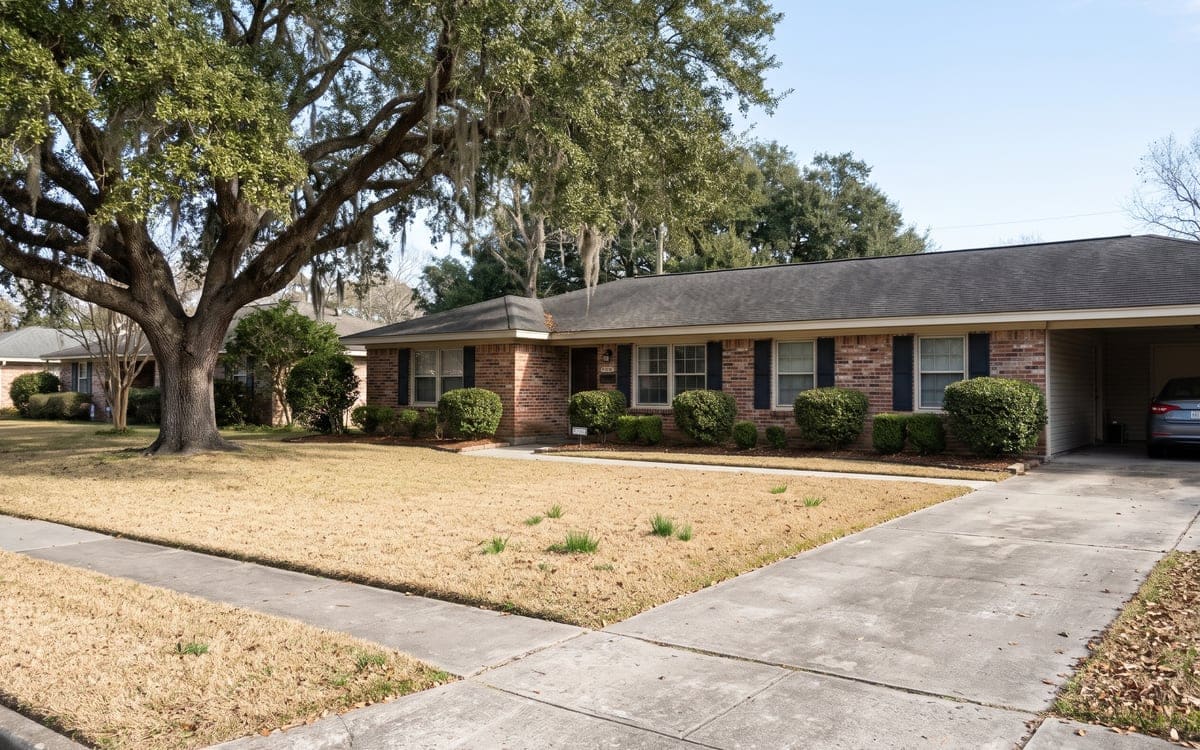
Dormant grass stops growing, so mowing mostly stops too
Warm-season lawns here run on a long cycle. The grass is in active growth from March through October and dormant from November through February, when mowing is generally not needed.1 The lawn is still alive underneath, holding its roots and the base of its runners while the top sits tan.
A cut needs something to cut. When the stand is not growing, the mower passes over it and takes nothing off. The last few cuts of the fall are the ones that set the lawn up for winter.
Dormancy here comes later than the calendar might suggest
The shutdown is not always clean. Most warm-season lawns here go fully or partly dormant by mid to late November or December, though St. Augustine may not go completely dormant in a mild south Louisiana winter.2 A December yard can carry patches of green on a St. Augustine lawn even while the stand as a whole is winding down.
Early winter is a judgment call. A yard that is clearly tan and quiet does not need a cut. A yard that is still pushing some growth late into November can get one more pass.
Winter weeds keep growing when the lawn does not
The reason the question of a winter cut comes up at all is weeds. Clover, lawn burweed and annual bluegrass stay active while turfgrasses look dormant.3 The dormant stand leaves open ground that cool-season weeds use.
A yard that was clean when the lawn shut down for winter can look different two months later. Scattered green patches show up where the weeds have taken hold, visible from the driveway on a yard that is otherwise tan.
A light cut can keep weeds from towering over the lawn
When winter weeds are standing above the lawn, a light cut can even things out. A pass at the same height the lawn held through the fall shortens the weeds without touching the dormant blades underneath. That is a mowing visit on a dormant yard, done to the weeds.
The weeds are still rooted after the mower passes over them. What a cut does is cosmetic: a yard reads as kept, the tall patches do not stand out from the drive, and the dormant grass underneath carries the usual look of winter rather than looking neglected. For a yard where weeds are heavier than the grass that is left, a mowing visit will not fix the underlying thinning.
What the visit covers in winter
Our visit, when it runs on a dormant yard, is mowing in the service of what the yard looks like. Hand pulling in beds and small patches is still available on a winter day with soft ground. Hand weeding in beds and small patches does not need the lawn to be awake. Spraying weeds is not part of a mowing visit.
Weekly or every-other-week mowing covers the lawn through the growing season.
St. Augustine may stay partly green through a Baton Rouge winter
Not every winter lawn turns the same color. St. Augustine may not go completely dormant during a mild south Louisiana winter.2 A yard that stays half green all season can look like it still needs mowing when it does not.
In January, check whether the blades are getting taller. A lawn that is holding color but not growing takes nothing off a mower pass and risks tracking soft winter ground. A lawn that is clearly putting on height during a warm stretch can take a cut at the grass's regular height.
Frosty mornings are not mowing mornings
Winter cuts also wait on the weather. Baton Rouge averages about 18 nights a year with a low of 32 degrees or colder4 and almost no days that stay below freezing. Those nights put frost on exposed lawns, and frosted grass does not cut cleanly. A mower pass over frost tears the frozen blade tips rather than slicing them.
A dormant-weed cut on a cold week waits until the yard is clear and the ground is dry.
| Winter condition | What the lawn is doing | What makes sense for mowing |
|---|---|---|
| Clearly tan and quiet | Fully dormant | No mowing; the mower would take nothing off |
| Tan with clover or annual bluegrass standing above | Dormant lawn, active cool-season weeds | A light cut can even out the top |
| Half green St. Augustine, not growing | Holding color through mild weather | Leave it alone until there is clear growth |
| Half green St. Augustine, clearly growing | Mild south Louisiana winter window | Cut at the grass's regular height |
| Frost on the lawn in the morning | Blades frozen and brittle | Wait until the yard thaws before any cut |
| Dormant tan lawn in late February | Early green-up may be starting | Watch for the first spring cut |
Spring green-up starts the season again
The quiet stretch has an end. Lawns in south Louisiana can start greening up in late February,3 and from there the lawn works its way into the growing season. That early green is a tinge, not a cue to mow.
What follows is the real start of the season. LSU AgCenter advises picking up sticks and winter debris before the first mow of spring, with that first cut going a little lower than normal.5 From there the weekly rhythm begins again, with grass cutting that holds the right height for the grass in the yard and clean edges with each cut.