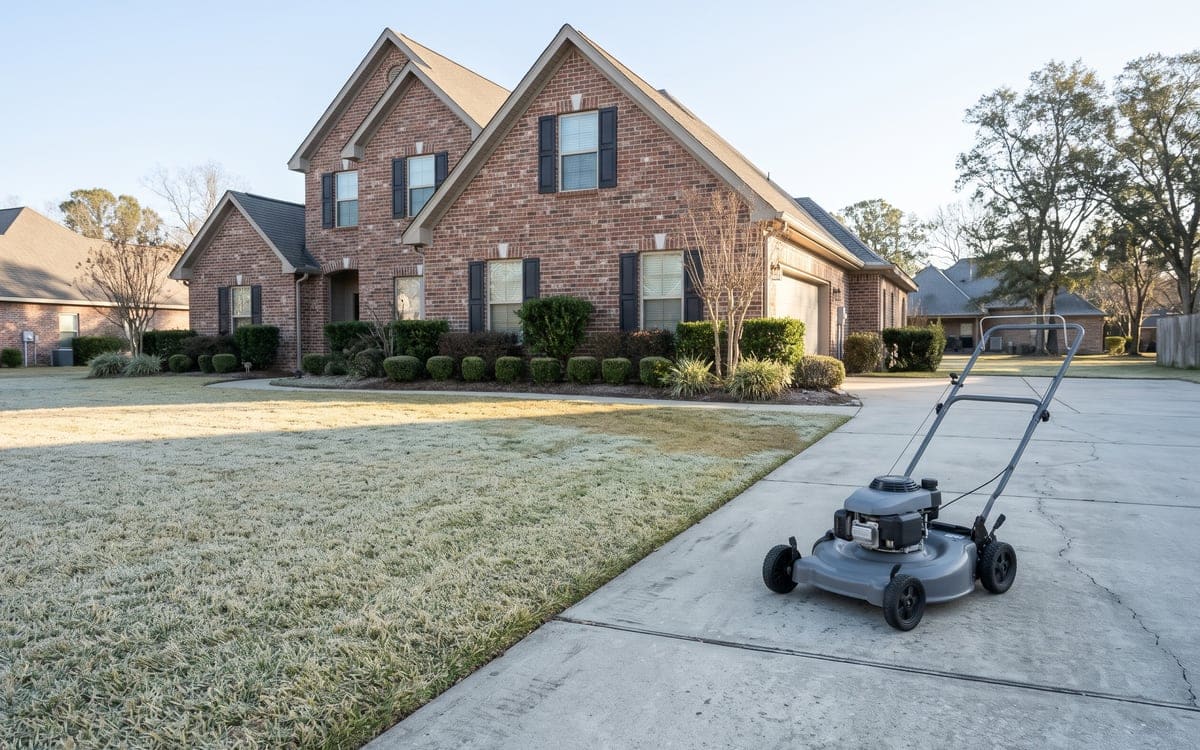
Frosted blades break instead of cutting
Grass blades hold water. On a cold morning that water freezes inside the leaf and the blade turns stiff. A rotary mower blade is a flail; it works by spinning fast enough to slice a soft, flexible leaf. A stiff frozen leaf does not slice. It snaps, bends and tears, and the ragged tips show up tan across the strips the mower passed over.
Walking across frosted grass leaves prints behind for the same reason. The step crushes the frozen cells; they lose their shape and the lawn carries the pattern until the blades grow out past the damage. Running a mower over a frosted lawn does the same thing on a bigger scale, with the added force of a spinning blade on top of it.
When a thawed yard is ready for the mower
A bright morning after a freezing night usually clears the yard once the sun has been on it for a while. The grass goes from gray and crisp to green or tan and limp, water comes off the blades, and the ground firms up. That is the window when a cut can run cleanly.
On a cold morning, the signs of a thawed yard are visible: light shows through the frost, the lawn looks wet rather than crystal-white, and footprints no longer stay behind as dark tracks. If the air is still so cold that the melted water refreezes in shaded spots, the cut waits a little longer.
What the airport normals show
Baton Rouge is on the warm side even in winter. The 1991 to 2020 normals from the airport show about 18 nights a year with a low of 32 degrees or colder, and almost no days that stay below freezing.1
Where the first freeze sits on the calendar
Baton Rouge's median first freeze (32 degrees) comes around November 26, and in one year in ten it comes by November 7.1 Separately, most warm-season lawns here go fully or partly dormant by mid to late November or December.2 A dormant lawn is dormant whether or not the airport has seen 32 yet.
The weeks leading up to the first freeze still take regular mowing to maintain proper height,2 on a slower pace than July. The last few cuts of fall hold the right height for the grass in the yard. The weekly or every-other-week pattern through fall is covered in the full lawn mowing schedule and the fall mowing guide.
A late freeze can still come after green-up
Winter's other number is on the back end. Baton Rouge's median last spring freeze (32 degrees) comes around February 25, but in one year in ten a freeze still comes as late as March 19.1
A late freeze over a lawn that has started to green up puts frost on blades that are starting to work again. The same rule applies in February as it does in January: a mower does not run on a frosted lawn. The yard thaws, the ground firms up, and the cut happens later in the day if the lawn is clearly growing.
Footprints on frost tell the same story as tire tracks
Any pressure on frosted grass leaves a mark. Footprints and tire tracks alike bruise the frozen cells, and the marks show up as darker, dulled strips once the frost lifts.
A mower track is wider because the deck covers the whole pass. The simple way to avoid any of that is to let the yard thaw, which costs the morning but not the lawn.
| What is on the yard | What it does to a mower pass | What makes sense |
|---|---|---|
| Visible white frost | Blades snap and tear | Wait for the yard to thaw |
| Lawn wet from thawed frost, sun on it | Mower can work, ground may still be soft | Walk the yard, decide pass by pass |
| Cold but no frost, lawn dry | Cut runs cleanly if the lawn is growing | Normal cut at the usual height |
| Soft, muddy ground after a rainy thaw | Tires track the lawn, bruise soft soil | Wait for the ground to firm up |
| Dormant tan lawn, no frost | Nothing to cut | Skip the mower, come back when the lawn is growing |
The call on a cold morning is more about judgment than a hard temperature. A yard that looks ready, feels firm under a shoe and is clearly dry is a yard that can take the mower.
A frosted morning does not change the cut, only when it runs
When a cut does happen later in the day, nothing else changes. The height is set for the grass in the yard. The yard still gets walked for sticks, toys, dog stakes, sprinkler heads and fire ant mounds before the mower runs. The usual edges and trimming happen as part of each weekly visit or as separate edging and trimming when that is what the yard needs.
A dormant yard does not need a cut even once the frost lifts. A yard still visibly growing in a mild stretch, or a yard with winter weeds standing above the lawn, can take a mower pass once the ground is clear. The call on whether to run the mower at all is a separate question from the frost itself.
What a thawed lawn looks like
The visual difference between a frosted lawn and a thawed one is clear once you watch for it. The frosted stand is pale and matte, with a dusting that catches light. A thawed stand is darker and reflective, with water beads clinging to the blades at first, then slowly wicking down. The ground firms up as the frost comes out. Shadows under hedges and against the north side of a house hold the frost the longest, which is why checking those spots before a cut matters.
A yard that has thawed on the sunny side but still carries frost in a corner can be mowed in sections. The sunny parts take the cut first, the shaded strip waits.
Edges and trimming are a separate pass
Edging and string trimming run with a different machine than the mower. Hedge trimming on an evergreen hedge is a different conversation.