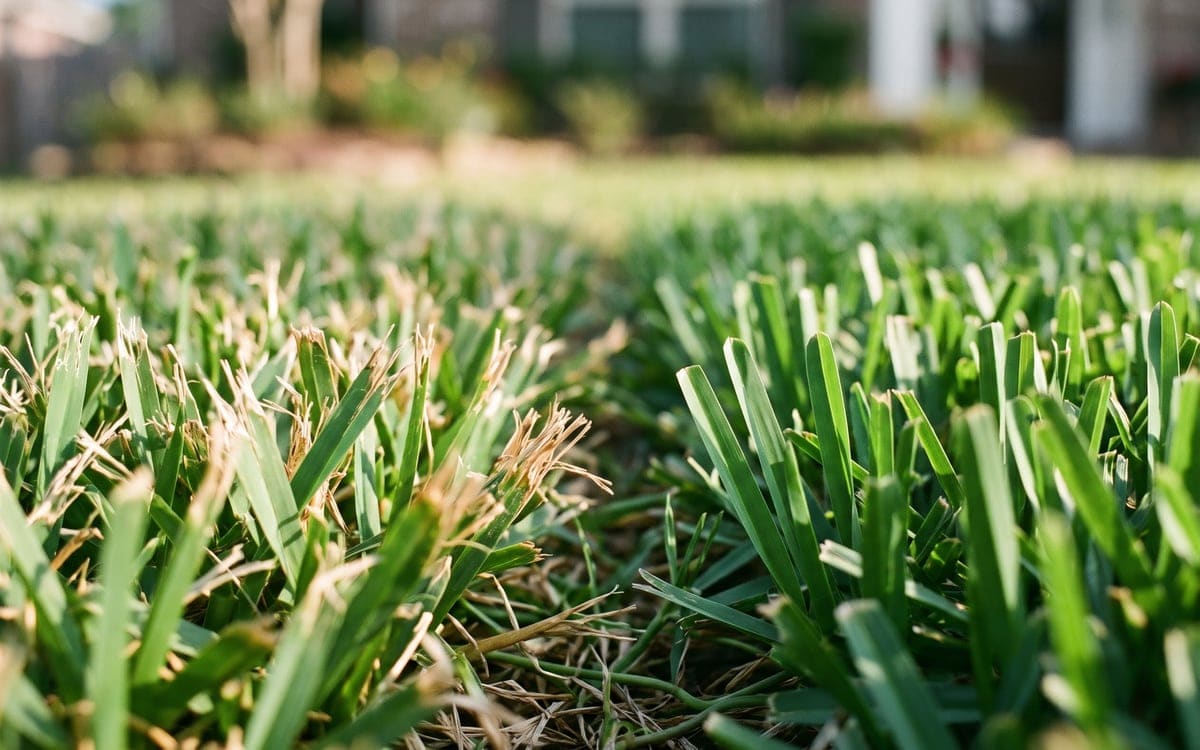
A dull blade tears the tip instead of cutting it
A rotary mower works by speed, not by sharpness in the way a kitchen knife is sharp. Still, the edge matters. On a sharp blade, the moving edge slices across the leaf and leaves a square, clean cut on the tip. On a dull blade, the edge pushes the leaf out of the way instead of slicing it, then catches it with the trailing side of the spin and tears the end.
Up close the difference is clear. A sharp cut tip looks like a knife-cut edge, straight across. A torn tip looks like a frayed thread, splayed at the top with white or tan fibers sticking out. On a thin-bladed grass that is hard to spot. On St. Augustine's wide blades, you can see it from standing height.
Frayed tips turn tan a day or two later
The torn end does not stay green. The open fibers lose water and dry, and within a day or two the ends turn tan. From the driveway the whole lawn looks faded, even though the growth underneath is still fine. A lawn that looks like it is drying out a week after a mow can be a lawn mowed with a dull blade.
That look lasts until the lawn grows out past the torn ends. In spring and summer growth, with weekly mowing, the tan edge gets cut off on the next pass, but if the next pass runs the same dull blade, the pattern repeats on the new tips.
Zoysia dulls blades quickly
Not every grass dulls a blade at the same pace. Rotary mower blades fray grass and dull after a few cuts, and tough grasses like zoysia dull a blade quickly.1 Zoysia's blades are stiff and dense, which is also why zoysia makes a tight, carpet-like lawn.
A few cuts are enough to lose an edge
LSU AgCenter puts the pace plainly: a rotary mower blade becomes noticeably duller after a few cuts and should be sharpened as needed.1 The pattern matters more than the exact count: a blade that was crisp at the start of the week can be noticeably off by the end of a busy spring stretch.
Picking up a stick, a stone or a sprinkler head accelerates it, which is why the first step on a yard is the walk, not the mower. A rock the blade clips once can take an edge off that a dozen clean cuts would not. That is why the yard walk for sticks, toys, dog stakes and sprinkler heads is a step by itself, before the mower runs.
Sharp blades matter most heading into fall
Fall lawns need regular mowing to maintain proper height and make sure that mower blades are still sharp.2 As cuts come less often in fall, each cut counts more. A torn tip in September has longer to show as tan before the next mow comes.
What a crew reads on the yard
A mowing visit opens with a yard walk. The lawn's own signal after a cut (clean square tips versus frayed, splayed ones) is what tells a crew whether the blade is doing its job.
What a homeowner can see from the driveway is the same signal. Frayed, splayed tips turning tan a day after a cut are the sign of a dull blade; square-cut tips the sign of a sharp one.
| What you see on the lawn after a mow | What it is likely telling you |
|---|---|
| Clean square tips, lawn stays even green | Sharp blade, right height |
| Frayed tips, tan edge across the lawn a day later | Dull blade dragged the grass |
| Streaks of tall grass between neater strips | Blade worn unevenly or deck not level |
| Patches of torn-looking grass only in one grass type | A tough grass is dulling the blade faster |
A dull blade is also a slower cut
The cosmetic side gets the attention, but a dull blade also makes the mower work harder. The leaf resists being cut, the blade loses speed through each pass, and a yard that should take one steady pass can take two.
A clean cut is also easier on everything the blade touches that is not grass. A sharp blade clips a few runners that creep over an edge cleanly. A dull one grabs and pulls them. Edging and string trimming handle the lines that a mower deck should not go after, which keeps the mower on the lawn.
What dull blades do not fix
Sharpening a blade is not a cure for mowing too low, mowing wet grass, letting a lawn get past the mower deck between cuts, or putting a light-duty deck on a dense yard. Those are different problems with different fixes. A lawn cut too low with a sharp blade still gets scalped; a lawn cut at the right height with a dull blade still frays.
The height, the schedule and the blade work together on a good cut. The height ranges by grass are covered in the fall lawn mowing guide.