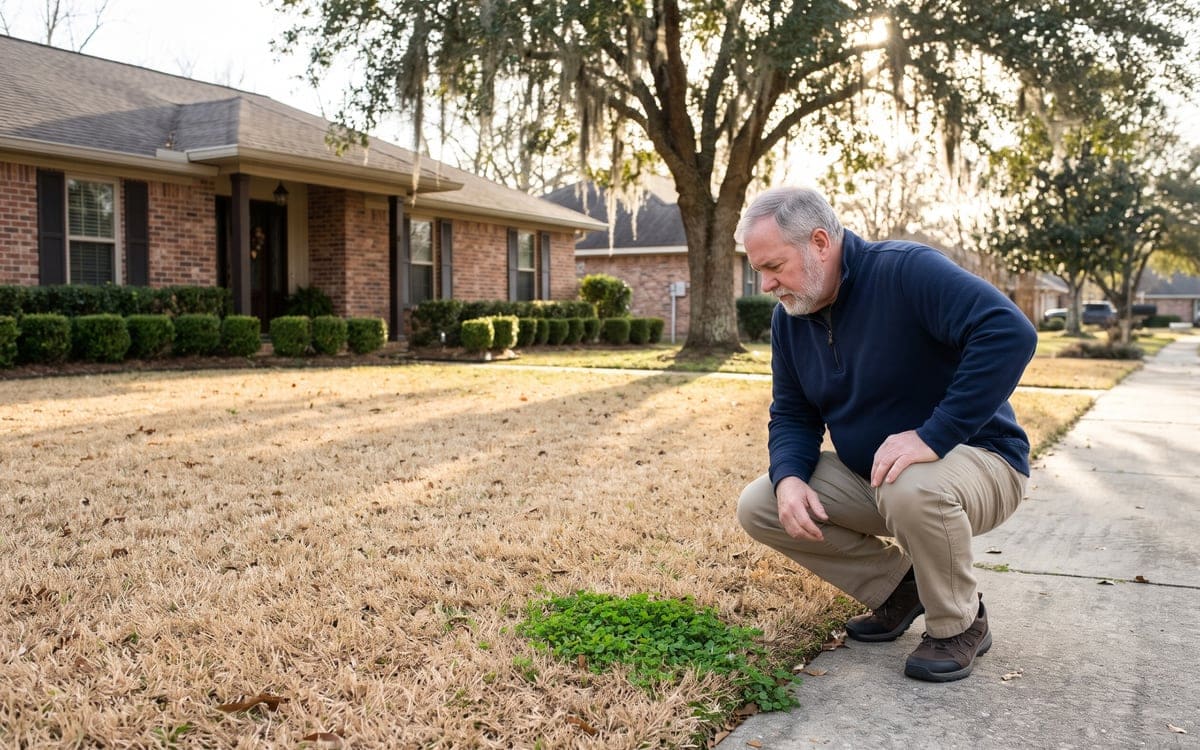
A dormant lawn leaves room for winter weeds
Warm-season grass here runs on a long cycle. Growth sits in the March to October stretch, with dormancy from November through February.2 While the lawn is dormant, the stand is still there, but it is not growing. New shoots are not filling in. The sunlight that would hit a dense summer lawn is now reaching the soil under the thinner winter cover.
Cool-season weeds use that opening. Clover, lawn burweed and annual bluegrass stay active through the dormant stretch1 while the lawn around them is quiet. A yard that was clean in September can carry small green patches by January.
January green is usually not the grass waking up
A Baton Rouge yard with scattered green patches in January is a mix of dormant lawn and cool-season weeds. St. Augustine is the exception: it may not go completely dormant during a mild south Louisiana winter,3 so a St. Augustine yard that holds color is a different pattern than a tan Bermuda or centipede yard with new green patches.
The lawn's own green comes later. Lawns in south Louisiana can start greening up in late February.1 The ground has to warm first; warm-season turf is not fully awake until the soil reaches a minimum of 60 degrees.4 A January green patch, on a non-St. Augustine yard, is usually a weed. A broad tinge across the stand in late February is the lawn.
Hand pulling works in beds and small patches
Hand pulling has its place. In a flower bed or a small patch at the edge of the lawn, pulling a weed by its root takes that plant out. New weeds can still come up from seeds in the soil. In a wider lawn with scattered weed cover, hand pulling is slow by nature and will not clear the yard.
The hand weeding service on this site is a bed and small-patch job rather than a whole-lawn weed clean-up. Edging that keeps bed and walk lines sharp is a separate pass. Short patches of winter weeds standing above a dormant lawn can also be shortened with a light cut, which is one of the specific reasons a visit might happen in winter (covered in mowing dormant grass).
Virginia buttonweed is the one that tolerates mowing
Virginia buttonweed is considered the most troublesome lawn weed in Louisiana for several reasons: its low growth allows it to tolerate mowing, its seeds can persist in the soil for long periods, and stem fragments are frequently spread via mowing.5
| What the yard shows | What is likely in it | What makes sense |
|---|---|---|
| Scattered green in a dormant lawn | Clover, lawn burweed or annual bluegrass, from the dormancy page | Light cut if above the lawn; hand pull in beds and small patches |
| Tan grass with no new growth | Dormant lawn, no weed problem | Nothing until spring green-up |
| Fresh green across the whole lawn in late February | Early green-up starting | Watch for the first spring cut |
Yards that have other weeds show other patterns.
Hand pulling in beds through winter
A weed pulling service in beds through winter takes the roots out while the ground is soft from rain. That is slower than a January yard owner usually wants, but it is work done on a scale that fits a bed.